Every time I start a new batch of students, I ask parents the same question: "When did you first think about teaching your child the Hanuman Chalisa?"
The answers are always the same. A family gathering where the elders chanted together. A temple visit where a child watched in wide-eyed wonder. A moment of quiet where a parent thought: I know this. Why doesn't my child?
And then comes the hesitation. Isn't it too hard? Isn't my child too young? Where do we even begin?
I've been teaching shlokas to children aged 4–10 for years now, and I want to tell you plainly: the Hanuman Chalisa is not too hard for young children. In fact, it's one of the most natural things in the world for them to learn — if you approach it the right way.
Why Young Children Are Perfect for This
There is a reason our ancestors started children on shlokas before they could read. The young brain is wired for sound, rhythm, and repetition. A child aged 5–8 absorbs language patterns the way a sponge absorbs water — effortlessly, joyfully, without the self-consciousness that comes with age.
The Hanuman Chalisa has a powerful internal rhythm — a meter called chaupai — that makes it naturally musical. Children don't hear it as "difficult Sanskrit." They hear it as a song. And children love songs.
"Within three classes, my 6-year-old was chanting the opening doha at breakfast. I hadn't even asked him to practice." — Parent, Shloka Nidhi
The Right Age to Start
I've taught children as young as 4, and I've seen remarkable results. But in my experience, 4–10 years is the sweet spot. At this age, children have enough attention span to engage with a full class, enough language ability to understand simple explanations of meaning, and enough social awareness to feel proud of what they're learning.
That said, every child is different. If your 4-year-old is curious and eager, don't wait. If your 9-year-old is just now discovering interest, it's absolutely not too late. I've seen older beginners surpass younger ones simply through enthusiasm.
How to Begin at Home
You don't need to be a trained singer or Sanskrit scholar. Here's what actually works:
- Start with the Doha. The two opening lines of Hanuman Chalisa are short, beautiful, and deeply meaningful. Learn just those two lines first. Master them before moving on.
- Play it daily. Find a recording you love — there are many beautiful versions — and let it play during morning routines, car rides, or before bed. Passive listening builds familiarity before active learning begins.
- Teach the meaning first. Children engage far more deeply when they understand what they're saying. Even a simple explanation — "This line is saying: I bow to my teacher, who is like a lotus flower" — transforms chanting from repetition into connection.
- Use rhythm, not drilling. Clap along. Sway. Make it playful. The moment it feels like homework, you've lost them.
- Be consistent, not intensive. Ten minutes every day beats one hour on weekends. The brain consolidates memory during sleep — daily practice is how it sticks.
What to Expect
In my classes, most children learn the complete Hanuman Chalisa across 20–25 sessions. That's roughly 4–5 months of weekly classes. But the progress isn't linear — there will be weeks where it feels like nothing is sticking, and then suddenly, something clicks.
The moment it clicks is unforgettable. A child who couldn't remember a single chaupai two weeks ago suddenly chants four of them without a single prompt. Their face changes. They stand a little taller. Something ancient has taken root in them.
That's what we're doing here. We're not just teaching words. We're giving children an identity, a lineage, and a sense of belonging to something much larger than themselves.
When Home Practice Isn't Enough
Many parents start at home with great intentions — and then life happens. The consistency slips. The child loses interest without the structure of a class. This is completely normal.
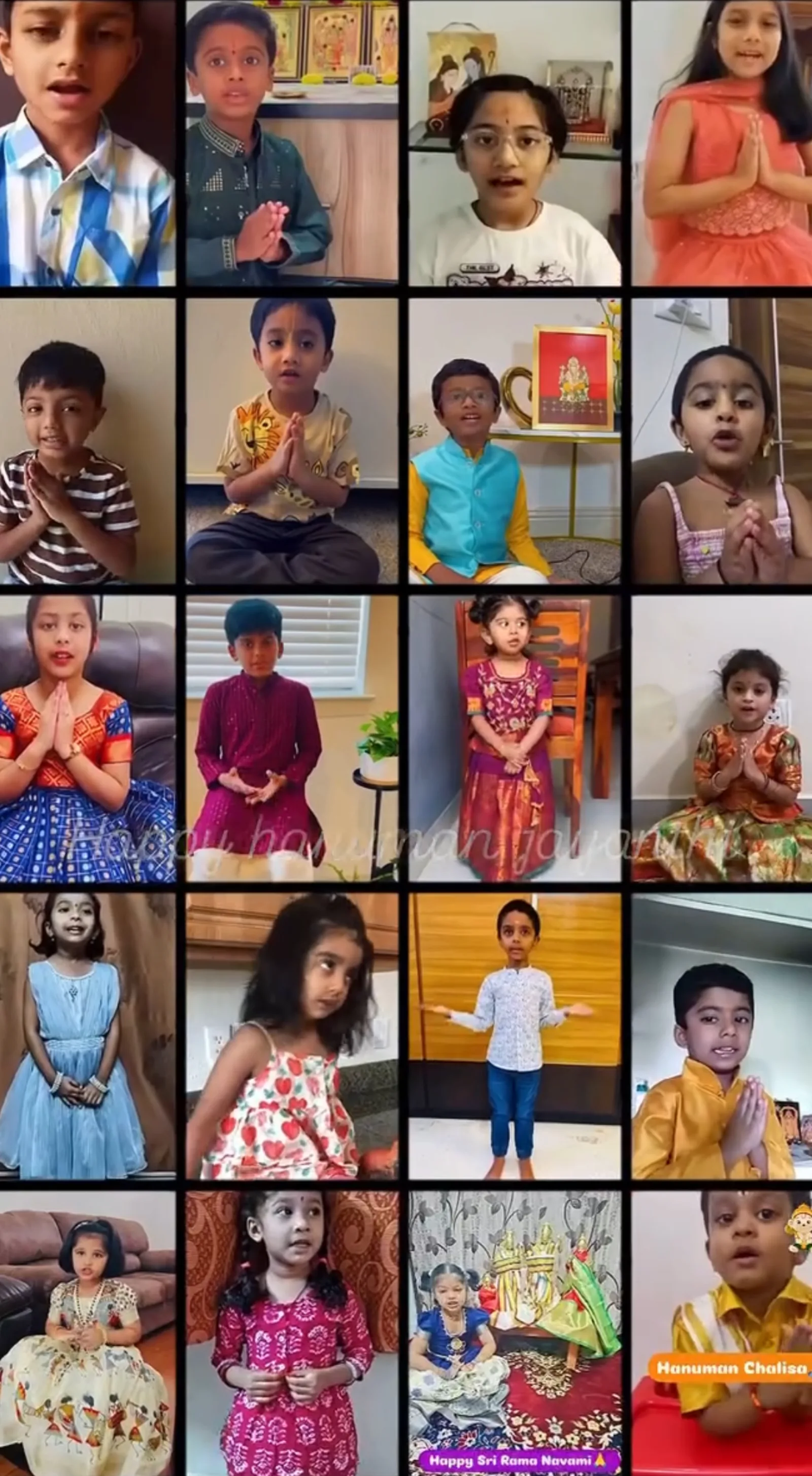
A structured class environment does something home practice can't: it gives children peers. When a child sees other children their age chanting the same verses, something shifts. It becomes something they do, not something their parents are making them do.
🙏 Start Your Child's Journey
Our Thursday Hanuman Chalisa batch is now open for new students aged 4–10. Live on Zoom, taught by Lavanya Anthanna.
📚 View Class Details →